
Calm Seas and Tempests: The Enduring Saga of Poseidon, God of the Ocean's Might
- akipage
- Jan 19, 2024
- 8 min read

Updated: Feb 5, 2024

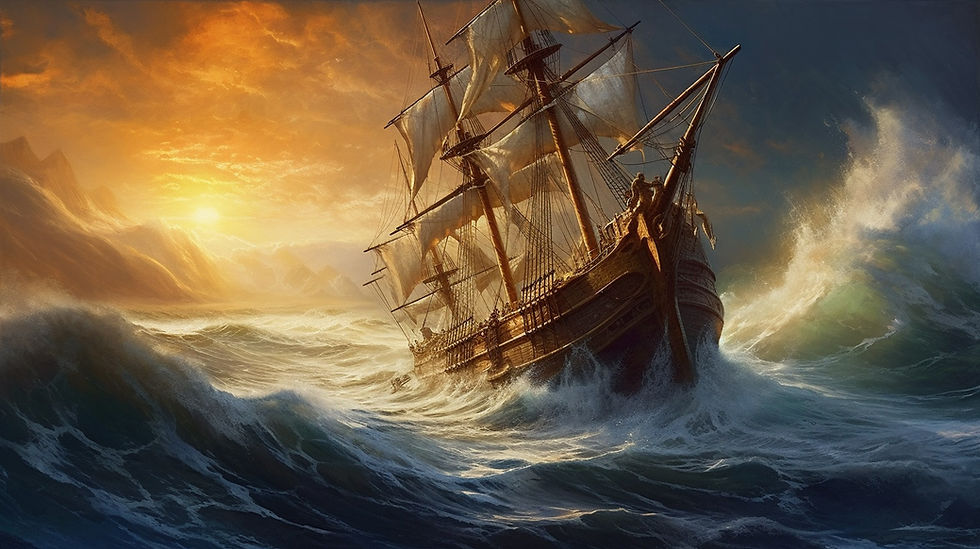
Imagine the formidable Poseidon: the god of the sea, storms, earthquakes, and horses. His commanding presence is a spectacle of mythic proportions, with a trident that churns the seas and skies. He stands, a colossal figure, his gaze spanning the breadth of the ocean's vast expanse. For millennia, this image of Poseidon has captured the imagination and awe of people, embodying the raw power and capricious nature of the sea.
In the intricate weave of ancient Greek religion and mythology, Poseidon holds a place of preeminence. As one of the Twelve Olympians, his realm was not just confined to the vast oceans but extended to the shaking of the earth and the creation of horses. Venerated as the protector of seafarers and guardian of numerous Hellenic cities, his influence permeated through the very core of Greek society. From the pre-Olympian Bronze Age where he was a chief deity in Pylos and Thebes to his veneration in Arcadia, Poseidon's cult spanned across various facets of Greek life. His dual associations as the tamer of horses and god of waters, along with the awe-inspiring title of "earth shaker," reflect a deity of immense power and complexity.
This essay will explore the multifaceted role of Poseidon in Greek mythology. We will delve into his origins, the breadth of his myths, and his profound impact on ancient Greek culture. From his division of the world with Zeus and Hades to his role in the epic tales of the Iliad and the Odyssey, and his influence in the legendary story of Atlantis, we will uncover how this deity of the sea emerged as a symbol of power, respect, and fear. Poseidon's story is not just one of mythic adventures but also a reflection of the ancient Greeks' understanding of the natural world and their reverence for the forces that shape it.
Poseidon’s Origins and Characteristics

Birth and Family
Poseidon's tale begins with the drama of the Titans. He was the son of Cronus and Rhea, two pivotal figures in Greek mythology. In a desperate attempt to evade a prophecy that he would be overthrown by one of his children, Cronus swallowed each of them at birth. Poseidon, along with his siblings, experienced this grim fate. However, their story didn't end there. Zeus, the youngest sibling, escaped this fate and later orchestrated a rebellion against Cronus. Through Zeus's cunning and might, Poseidon and his other siblings were freed from their father's belly. Following their triumphant victory over the Titans, the three brothers, Zeus, Poseidon, and Hades, cast lots to divide the realms of the world. Poseidon drew the dominion of the sea, while Zeus claimed the sky, and Hades received the underworld. This division established Poseidon as a potent ruler of his watery domain, a god whose influence would touch every corner of the ancient world.
Attributes and Symbols
Poseidon's identity and powers are symbolized by his most iconic attribute: the trident. A three-pronged fishing spear, the trident represents his dominion over the sea and his ability to control and influence all aquatic elements. With a strike of his trident, Poseidon could stir up tempestuous storms, provoke devastating earthquakes, and even create springs. In Greek, the connection between horses and springs is linguistically significant, further emphasizing Poseidon's unique association with these aspects of nature. His temperament was as unpredictable as the sea he ruled - capable of being calm and benevolent one moment, and ferociously tempestuous the next. This duality in his nature was a reflection of the sea's unpredictable and often violent character, which the Greeks both revered and feared. Poseidon's Roman equivalent, Neptune, inherited many of these attributes, underscoring the trans-cultural significance of this formidable deity. Neptune shared not only Poseidon's control over the seas but also his symbolic representation through the trident, an emblem of both power and maritime dominion.
Myths and Stories

Famous Myths
Poseidon, a deity of many facets, played crucial roles in various Greek myths, each showcasing different aspects of his character and powers. In Homer's epic, "The Iliad," Poseidon is depicted as a supporter of the Greeks during the Trojan War, demonstrating his influential role in mortal affairs. His intervention in the war showcases not only his formidable strength but also his interest and participation in the fates of mortals.
Another significant mythological narrative featuring Poseidon is found in Homer's "Odyssey." Here, Poseidon is portrayed in a more vengeful light, punishing the Greek hero Odysseus for blinding his son, the Cyclops Polyphemus. This act of retribution by Poseidon leads to Odysseus's prolonged and perilous journey home, filled with numerous trials and tribulations. This story highlights Poseidon's protective nature towards his children and his willingness to exact revenge.
Additionally, Poseidon plays a central role in the legend of Atlantis as detailed in Plato's dialogues "Timaeus" and "Critias." In this myth, Poseidon is the god who begets the first kings of Atlantis, a civilization that Plato describes as an ideal society that eventually falls out of favor with the gods. Poseidon's connection to Atlantis underscores his association not just with the sea but also with the rise and fall of civilizations, and his influence in the shaping of human societies.
Analytical Insight

These myths collectively underscore Poseidon's multifaceted nature. His portrayal as a supporter of the Greeks in the Trojan War and as the wrathful deity punishing Odysseus reflects the Greeks' complex relationship with the sea - a source of sustenance and wealth, yet unpredictable and often dangerous. Poseidon's vengeful pursuit of Odysseus for harming Polyphemus illustrates the ancient Greek belief in divine retribution and the consequences of offending the gods.
In the story of Atlantis, Poseidon's role highlights the Greeks' understanding of the gods' involvement in the rise and fall of societies, serving as a reminder of the divine influence in human affairs and the transitory nature of human glory. These myths collectively paint a picture of Poseidon as a deity deeply intertwined with both the natural and human worlds, wielding immense power over the seas and profoundly influencing the course of human history.
Poseidon’s Influence and Worship
Worship Practices
The worship of Poseidon was widespread throughout ancient Greece, particularly prominent in coastal cities and islands where the sea was a crucial part of daily life. His temples served as significant centers for worship and were often located in strategic maritime locations, reflecting his dominion over the sea and earthquakes. For instance, in Corinth, a city known for its Isthmian Games, Poseidon was revered as the chief deity, with his temple being a focal point of the city's religious and civic life. These games, held in honor of Poseidon, included both athletic and musical competitions, showcasing the god's importance in both physical prowess and the arts.
Poseidon's worship was not limited to grand temples and festivals. Smaller, more localized rituals and offerings were commonplace, especially among seafarers and fishermen who sought his favor for safe voyages and bountiful catches. His influence was so pervasive that his worship extended to the Ionian colonies and cities in southern Italy, a testament to the spread of Greek culture and the reverence for Poseidon's power across the Mediterranean.
Cultural Influence

The influence of Poseidon in ancient Greek culture extended far beyond religious worship. He was a prominent figure in Greek art and literature, symbolizing the awe-inspiring and often capricious nature of the sea. In literature, he appears in various forms, from the supportive deity in "The Iliad" to the vengeful god in "The Odyssey," reflecting the Greeks' respect and fear of the sea and its unpredictable nature.
In Greek art, Poseidon was frequently depicted with his trident, and his imagery was a common motif in pottery and sculpture. This artistic representation mirrored the Greeks' understanding and interpretation of their environment, particularly the sea, which was both a source of sustenance and a formidable threat.
Moreover, Poseidon's influence permeated Greek seafaring traditions. As the protector of seafarers, rituals invoking his protection were an integral part of maritime voyages. This reverence for Poseidon among sailors and fishermen underscores the critical role of the sea in ancient Greek life, both as a means of travel and commerce and as a key element in their mythology and cultural identity.
In summary, Poseidon's worship and cultural significance in ancient Greece were multifaceted, reflecting his complex nature as a deity. He was not only a god to be appeased through worship and rituals but also a central figure in the artistic and literary expressions of the Greeks, embodying their deep connection with and respect for the sea.
Poseidon in a Broader Context
Modern Relevance
The legacy of Poseidon extends far beyond ancient Greek mythology into the modern era. His image and myths continue to resonate, finding expression in contemporary media and literature. Poseidon’s portrayal in modern fiction often mirrors his ancient characteristics – powerful, temperamental, and closely tied to the sea. In psychology, Poseidon's temperamental nature and his control over the unpredictable sea have been used metaphorically to represent the human subconscious and the untamed aspects of nature and human emotion.
Moreover, Poseidon’s myths have been adapted in various forms, from movies and television shows to literature, showcasing the continued fascination with Greek mythology and its relevance in modern storytelling. This enduring presence underscores the timeless allure of mythological figures in understanding and contextualizing natural phenomena, human emotions, and experiences. Poseidon’s character serves as a symbol of the primal power of the sea and natural forces, reminding modern audiences of the enduring influence of ancient myths and their ability to convey fundamental aspects of human experience and the natural world.
Conclusion
Throughout this essay, we have journeyed through the compelling narrative of Poseidon, one of the most revered deities in ancient Greek mythology. Starting from his dramatic origins as the son of Cronus and Rhea, we have explored his emergence as a pivotal figure among the Twelve Olympians, ruling the seas, storms, earthquakes, and horses. We delved into the myriad myths surrounding Poseidon, from his role in the Trojan War as depicted in Homer's "Iliad" to his vengeful pursuit of Odysseus in "The Odyssey," and his association with the legendary Atlantis in Plato's "Timaeus" and "Critias."
Poseidon's profound impact on ancient Greek culture was highlighted through his widespread worship across Greece, especially in coastal cities and islands. His temples, rituals, and festivals, like those at Corinth, played a central role in civic life, reflecting his significance in the daily lives of the Greeks. Furthermore, we examined Poseidon's far-reaching influence beyond religious practices, noting how deeply he was embedded in Greek art, literature, and seafaring traditions, shaping the Greek identity in relation to the sea.
In a broader context, we compared Poseidon with similar sea deities of other ancient civilizations, such as the Roman Neptune, illustrating the cross-cultural significance of sea gods. Finally, we observed the enduring relevance of Poseidon in modern times, where his image and myths continue to appear in contemporary media, literature, and psychology, symbolizing the primal power and unpredictability of the sea and natural forces.
Poseidon's enduring presence in both ancient and modern narratives is a testament to the timeless allure of mythology. His story is not merely a collection of myths but a reflection of the ancient Greeks' attempts to understand and explain the natural phenomena and experiences that shaped their world. Poseidon, with his commanding and multifaceted nature, remains a symbol of the awe-inspiring and often capricious forces of nature. His legacy continues to captivate and inspire, reminding us of the enduring power of mythology to convey the profoundest aspects of human experience and our relationship with the natural world.
Ancient Texts
Homer's "Iliad" - Offers early references to Hades and the Greek pantheon, contributing to our understanding of the gods' roles and relationships.
Homer's "Odyssey" - Particularly the Nekyia, where Odysseus ventures into the underworld and encounters Hades, providing insights into the Greek conception of the afterlife.
Hesiod's "Theogony" - Provides an account of the origins of the gods, including Hades' birth and his role in the division of the cosmos post-Titanomachy.
Virgil's "Aeneid" - Though Roman, it offers a perspective on the underworld and includes references to Greek mythology and Hades (Pluto in Roman mythology).
Modern Scholarly Interpretations
"The Greek Myths" by Robert Graves - Provides detailed retellings and analyses of Greek myths, including those concerning Hades, with interpretations of their symbolic meanings.
"Greek Religion" by Walter Burkert - A comprehensive study of ancient Greek religion, including the cult of Hades and the rituals associated with death and the afterlife.
"The Gods of Olympus: A History" by Barbara Graziosi - Offers an exploration of the evolution of the Greek gods, including Hades, from their origins to their roles in modern culture.


Comments